A Writing Framework
Claude’s Context
The user is building a personal writing framework for publishing articles — likely on LinkedIn or a similar platform — where the goal is resonance over reach. They’re not optimising for engagement metrics or algorithmic performance; they’re writing for a specific audience who will genuinely connect with the ideas.
The framework serves two purposes simultaneously: using writing as a thinking tool (input pass) to gain genuine clarity on what they actually believe, and then shaping that into something that earns engagement through precision and honesty rather than formulaic tension-signalling.
The underlying philosophy is that good writing doesn’t tell readers what to feel — it constructs the conditions for them to feel it themselves. That’s what separates it from the LinkedIn-bot style of content that mimics the structure of good writing without doing the actual work.
The two passes
Writing serves two different people at different times — you first, then your reader. Conflating them produces work that is neither clear to you nor engaging to them.
Input pass (for you) — write without editing. Chase the question. The goal is not a draft; it’s an honest answer to: what do I actually believe here, and why? You’re done when you’ve surprised yourself.
Output pass (for them) — now you have something real to say. Structure it so the reader arrives at the insight themselves rather than being told it exists.
Input pass
One question: have you surprised yourself yet?
If yes, stop. If no, keep writing. Any other criteria is output-pass thinking arriving too early — it kills the exploration before you find the thing worth saying.
Output pass
Structure
Every piece follows the same spine:
- Hook — creates a question in the reader’s mind
- Tension — why is the answer non-obvious? What do most people believe, and why is that incomplete? This earns the right to your insight.
- Insight — your actual point. One sentence if the input pass went well.
- So what — what should the reader do, think, or feel differently? This is what makes people share — not the insight itself, but the feeling of being changed by it.
Show, don’t tell
The goal is to put the reader inside the moment, not announce that the moment exists.
Telling: “most people get this wrong” Showing: describe the specific situation where the mistake happens — the reader recognises themselves, feels the tension, and arrives at your reframe as if it were their own thought.
Ideas feel more powerful when the reader discovers them. You’re constructing the conditions for that discovery.
The TV drama vs sitcom distinction: a good drama trusts you to feel the emotion from the scene. A bad sitcom pipes in a laugh track to tell you when something is funny. LinkedIn bots are laugh tracks — they announce tension (“here’s what most people miss”) rather than creating it. Write drama.
Proofreading the output pass
Three passes, one lens each:
Meaning pass — does every sentence say exactly what you mean? Check for unconscious hedging (“kind of”, “in a way”) and decide deliberately whether it belongs.
Earning pass — label each paragraph as either building tension or delivering insight. If you can’t label it, cut it.
Skeptic pass — read it as someone who mildly disagrees with you. Where would they check out? Where is the logic a leap taken on faith? Those spots need more showing.
One technique that cuts across all three: read it aloud. Your mouth catches what your eyes skip.
The relationship between the two passes
They are sequential, not parallel. You cannot write something engaging until you are clear on what you actually think. Skipping the input pass produces work that is organised but not interesting — because the writer never found their real point.
The showing-not-telling discipline in the output pass only works if there’s something genuine to show. That’s what the input pass is for.
The writing compass
Two axes determine the character of a piece of writing. Craft (vertical) is about what the writing does at the sentence level — does it create tension through showing, or announce it through telling? Disposition (horizontal) is about the posture behind the writing — is authority earned through specificity, or assumed from position?
The goal is the top-left quadrant: guerrilla drama. Writing that finds its way in through the side door because it has to, and constructs the conditions for the reader to feel something rather than instructing them to. The trap is bottom-right: imperial sitcom — the LinkedIn-bot mode, where tension is signalled rather than created, from a position of assumed authority.
The two axes are independent. Imperial drama (top-right) is polished, well-crafted writing that still writes from authority — think certain long-form journalism or TED-style essays. Guerrilla sitcom (bottom-left) is personal and honest in disposition but lazy in craft — the anecdote that goes nowhere.
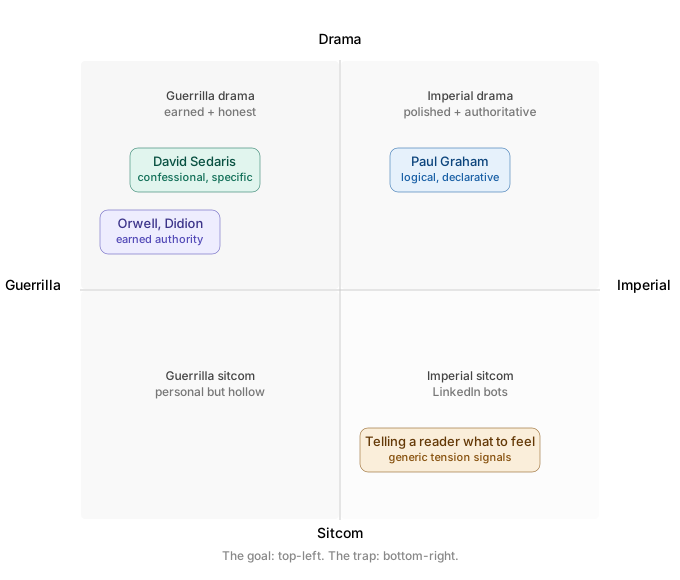
The writing compass
* * *
Arie’s Notes
Stuff that I am adding as I go.
Personal vs Critical
Consider two types of essays: personal essay and critical essay. The former is like saying “here’s how I tried to make sense of a thing” while the latter is like saying “here’s what is objectively true about a thing”.
At the core of the personal essay there is the supposition that there is a certain unity to the human experience.
Orwell
The whole tendency of modern prose is away from concreteness. https://gutenberg.net.au/ebooks02/0200151h.html
Question for when I’m writing or reviewing: does this passage easily evoke mental imagery? Or is the meaning clouded despite multiple re-reads?
The great enemy of clear language is insincerity. When there is a gap between one’s real and one’s declared aims, one turns, as it were instinctively, to long words and exhausted idioms, like a cuttlefish squirting out ink.
What is above all needed is to let the meaning choose the word, and not the other way about.
When you think of a concrete object, you think wordlessly, and then, if you want to describe the thing you have been visualizing, you probably hunt about till you find the exact words that seem to fit it. When you think of something abstract you are more inclined to use words from the start, and unless you make a conscious effort to prevent it, the existing dialect will come rushing in and do the job for you, at the expense of blurring or even changing your meaning.
If you simplify your English, you are freed from the worst follies of orthodoxy. You cannot speak any of the necessary dialects, and when you make a stupid remark its stupidity will be obvious, even to yourself.
* * *
Excerpt:
To begin with, it has nothing to do with archaism, with the salvaging of obsolete words and turns of speech, or with the setting-up of a “standard-English” which must never be departed from. On the contrary, it is especially concerned with the scrapping of every word or idiom which has outworn its usefulness. It has nothing to do with correct grammar and syntax, which are of no importance so long as one makes one’s meaning clear, or with the avoidance of Americanisms, or with having what is called a “good prose style.” On the other hand it is not concerned with fake simplicity and the attempt to make written English colloquial. Nor does it even imply in every case preferring the Saxon word to the Latin one, though it does imply using the fewest and shortest words that will cover one’s meaning. What is above all needed is to let the meaning choose the word, and not the other way about. In prose, the worst thing one can do with words is to surrender them. When you think of a concrete object, you think wordlessly, and then, if you want to describe the thing you have been visualizing, you probably hunt about till you find the exact words that seem to fit it. When you think of something abstract you are more inclined to use words from the start, and unless you make a conscious effort to prevent it, the existing dialect will come rushing in and do the job for you, at the expense of blurring or even changing your meaning. Probably it is better to put off using words as long as possible and get one’s meaning as clear as one can through pictures or sensations. Afterwards one can choose—not simply accept—the phrases that will best cover the meaning, and then switch round and decide what impressions one’s words are likely to make on another person. This last effort of the mind cuts out all stale or mixed images, all prefabricated phrases, needless repetitions, and humbug and vagueness generally. But one can often be in doubt about the effect of a word or a phrase, and one needs rules that one can rely on when instinct fails. I think the following rules will cover most cases:
- Never use a metaphor, simile or other figure of speech which you are used to seeing in print.
- Never use a long word where a short one will do.
- If it is possible to cut a word out, always cut it out.
- Never use the passive where you can use the active.
- Never use a foreign phrase, a scientific word or a jargon word if you can think of an everyday English equivalent.
- Break any of these rules sooner than say anything barbarous.
These rules sound elementary, and so they are, but they demand a deep change of attitude in anyone who has grown used to writing in the style now fashionable. One could keep all of them and still write bad English, but one could not write the kind of stuff that I quoted in these five specimens at the beginning of this article.
Orwell is lamenting that the English written by his contemporaries is being influenced by indirect and imprecise language used by politicians and academics. A politician might deliberately use euphemisms to avoid evoking vivid imagery, such as that of overseas conflict. Orwell correctly points out that if you can’t clearly define your counterpart’s statement, you have no hope of opposing it. Clichés tend to emerge to compensate for an author’s knowledge gaps, presumably they sound “about right”, which results in imprecision. Finally, foreign words (such as Latin words used in academia, or French words, German words etc.) are often used to give a sense of intelligence or culture, and should be avoided as well. The takeaway, if you want to write like Orwell, is to get to the point quickly, avoid using clichés, be succinct, write in the active voice when possible, and avoid foreign language.
Orwell demonstrates it is indeed possible to write engaging articles under these rules: “like a cuttlefish squirting out ink”.